Tuesday, 2 April 2013

Dans mon sac - Authentic songs in MFL

When it comes to writing schemes of work many language teachers become obsessed with doing what they have always done.

One of these things is the "dans mon sac" unit where students are taught all the words for stationery items. 

If you've ever been to France you'll hear people talking about nothing else....stylo this.....règle that...bâton de colle...trousse...

OK, I may have made that last bit up. 

One of the reasons I believe students are turned off by languages is the "baby" stuff we do with them. 

Before you get annoyed, I'll explain. In History in KS3 in England and Wales, students study the national and global effects of the reign of Queen Elizabeth I. In Geography they study urban design, crime, and climate change. In Maths, it's algebra. In Science, students learn particle theory...

...and then they go to French and learn the "classroom words" for stationery items and, quite possibly, stationary items.

In February at #ililc3 I was talking to a lady about how I had used this song to teach year 8 students the "tu" form of verbs in the present tense and then got students to practise by writing their own verse using what they had learned.


This being the Easter break and having time to do things, got me searching for other songs which could be exploited and this morning I came across this song "Dans mon sac" by Alizée.


This song was only released on the 25th March so you probably won't have heard it before.

The lyrics are clear, sung slowly and quite simple.

You could exploit this by getting students to write their own lyrics (simplify it by creating a gapfill exercise - the lyrics are here) and perhaps then include things which they really have in their own school bags.

Much more fun and creative than the "écoutez et répétez" Longmans Audio Visual French type activities which so many of my colleagues love.

Friday, 29 March 2013

Quizdini


Quizdini is a free site which allows teachers to create custom quizzes for students.

You sign up and build quizzes.

It's that simple.

There are 2 types of games which you can create: multiple choice games and matching games.

To create a multiple choice game you enter the title of your quiz, add a question with the correct answer and 3 wrong answers, then add more questions.

There is even a box where you can explain why an answer is correct.

When you have finished you save the quiz.

You can add the link to a blog or wiki but I'm fairly sure that you can't embed them as yet.

There are a lot of quiz builder sites around but I like this one because you can use foreign characters.There is even a drop down box with accented letters in it which you just click on to insert them.

Here is an example of a multiple choice game which I built in only a few minutes which tests knowledge of irregular past participles in French.

The quiz can be played in "practice mode" or "race mode". In "race mode" there is a timer.

If students get a question wrong they lose a life or "magic wand" as Quizdini calls it.

After losing 10 magic wands, or answering all the questions, the game is over.

Personally, I wouldn't use this kind of exercise in class but they provide an ideal opportunity for students to practise and revise grammar and vocabulary independently.

Sunday, 10 March 2013

That's easy for you to say...

As you are probably aware, I like languages.

One of the things I love about different languages is that there are some words which cannot be translated into English.

I found this picture on cheezburger.com which shows this to great effect:


I started searching the net for more examples and found a site called: betterthanenglish.com which is dedicated to these types of phrases.

One of my favourites is the hungarian word,

Donaldkacsázás 


which literally means "Donald Ducking" and is a word used to describe the act of wearing a shirt but nothing else whilst wandering around the house.

I also like: 

Tsundoku


the Japanese word for buying books but never reading them and allowing them to pile up at home. This is something I do a lot.

A further search found this site: ackuna.com/badtranslator. 

On this site you enter a phrase in English and it uses various online translators to keep translating your phrase into different languages and then back into English when it has something incredibly amusing or just completely unlike the original text.

So entering: 

I love learning French.

was translated as:

France is correct.

It's the most fun you can have with an online translator.

Or as bad translator would say: 

Get the best in online gaming.

Friday, 1 March 2013

Newsmap - a fantastic resource.

I was made aware of Newsmap during my #ililc3 workshop on how to motivate students at AS and A2.

Sadly, I can't remember who it was who put me on to it, so I'm unable to give them the credit. If it was you, let me know.

Newsmap describes itself as "an application that visually reflects the constantly changing landscape of the Google News aggregator".

It brings together the main news stories from Argentina, Australia, Austria, Brazil, Canada, France, Germany, India, Italy, Mexico, The Netherlands, New Zealand, Spain, The United Kingdom, and the USA.

It is ideal for anyone teaching foreign languages to a higher level as it is an invaluable source of current news in different languages.

It is constantly updated and provides links to international, national and regional news stories.

You can see how the page is set out from this screenshot:


All you need to do is click on the headline of your choice and the link will be opened in a new tab.

Because you are now saying to yourself "I wish I'd known about this 3 weeks ago" I'll tell you that there is also a search facility enables the user to find stories in any of the languages, too.

I thoroughly recommend it.
    

PS I've just been reminded that it was Annalise Adam who recommended it to me

Saturday, 23 February 2013

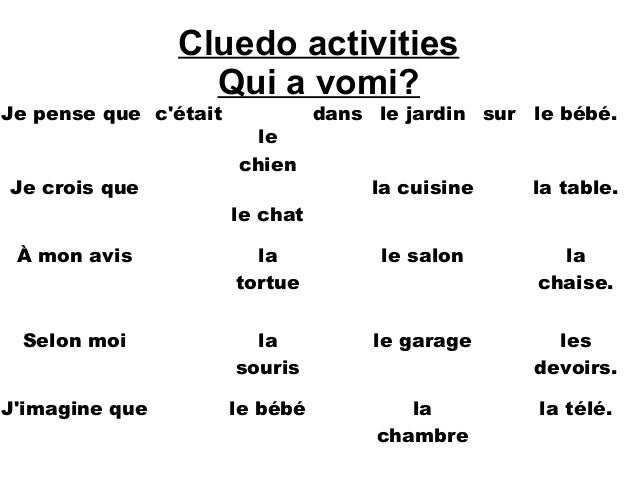
Cluedo - a speaking activity

Cluedo  (or Clue if you live in the USA), as you all know, is a board game, card game, and a computer game in which players try to discover the identity of the murderer of Dr David Black (UK) or Mr John Boddy (US).

Using their powers of deduction (or in the case of my little sister, random, wild guesses), players have to identify the name of the killer, the place the crime was committed and the weapon used.

I always use Cluedo as the example for explaining what a noun is: A person (Miss Scarlett), a place (the library) a thing (lead piping).

A few years ago I happened to be at a CPD event at Ian Ramsey School in Stockton-on-Tees where one of the presenters, John Connor, introduced me to a Cluedo-based guessing game to get students speaking.

So here's how to play:

1) Either make or find a worksheet or create a powerpoint with the key information on it
    Here's a favourite of yr8 boys:
2) The teacher (or a student) writes on a mini-whiteboard the 3 key pieces of information:
e.g. le chien, la chambre, les devoirs

3) Students try to guess by saying full sentences. For example: Je pense que c'était le chat dans le jardin sur la table.

4) For each piece of correct information given the guesser is awarded one point. The teacher can only say "zéro" "un" "deux" or "fantastique!" 

5) The student who guesses all 3 pieces of information correctly wins and then gets to be "the teacher".

I have found, with most groups, that the students forget that they are speaking in the target language and really enjoy this activity.

Wednesday, 20 February 2013

i-pads - an apology

Over the last couple of years I have been accused of being "anti-apple".

I now admit that, taken out of context, some of my comments about certain fruit-based products could be misconstrued as negative but I can assure you all that this is not the case.

You may recall that I attended #ililc3 at Southampton University on the 9th & 10th of February?

Many of the delegates there were in possession of tablet computers of all brands, shapes (mostly rectangular) and sizes.

I approved wholeheartedly.

The reason being that these people were using them properly.

By which I mean they were using them for things other than as teacher planners or very expensive 1980s "game and watch" consoles.

I even designed the handouts for my workshop "From squawk to talk" with QR codes so that tablet users could access the links instantly and without any fuss.

I also discovered lots of new applications (I still can't bring myself to say, or type, "apps") for both android and apple which would be fantastic should they be used in the MFL classroom.


So, if you are an apple user - I really am very sorry.

Monday, 18 February 2013

Motivating students at AS & A2 (#ililc3)

This is the presentation from my 2nd workshop at #ililc3.

It contains a lot of ideas and many links to sites which I have used in my teaching.

I think the workshop went down well with the delegates and, like my other workshop, I set out the presentation so that it could be used and understood by those who were not fortunate enough to be at the conference.